
Skip training wheels entirely
A balance bike teaches a toddler to steer and stay upright before they ever have to worry about pedaling, which is why kids who start on one usually skip training wheels altogether.
The gap between a good balance bike and a bad one comes down to weight, seat range, and tires — a bike that’s too heavy for a 2-year-old to lift or too tall to straddle just gets pushed to the garage corner. The best options here adjust low enough for an 18-month-old to get both feet flat on the ground, stay light enough for a toddler to actually maneuver, and use flat-free tires so a flat doesn’t end riding season.
- Seat height matters more than age range Ignore the age range on the box and measure your kid’s inseam against the bike’s lowest seat setting — a bike that’s too tall means white-knuckle rides and a kid who gives up fast.
- Weight is the difference between fun and frustrating A bike under 4 lbs is dramatically easier for a toddler to lift, turn, and control than a 7-lb steel frame, especially in the first few wobbly weeks.
- Flat-free tires save your sanity Foam or solid rubber tires never go flat and never need air, which matters a lot when the rider is too young to tell you why the bike suddenly feels wrong.
- Balance bikes beat training wheels for the transition Kids who learn balance first typically move straight to a pedal bike without stabilizers, because they’ve already mastered the hard part — staying upright.




Best Overall: Strider 12 Sport, No Pedal Balance Bike for Kids Ages 1–4 Years, Pink
Best overall pick for first-time riders ages 1-4
An 11-17 in. adjustable seat and 6.7 lb steel frame let it grow with toddlers from age 1 to 4, while flat-free foam tires keep first rides trouble-fre
- Seat and grips adjust without tools, so it grows with the kid over years, not months
- Steel frame shrugs off curbs, gravel, and being dropped repeatedly
- Foam tires never need air and never go flat mid-ride
- Strider’s balance-bike racing scene gives motivated kids something to grow into
- 6.7 lbs is noticeably heavier than the aluminum options here for a brand-new 1-year-old
- Pink colorway won’t suit every family or every second kid down the line
- No footrest, so younger riders sometimes drag their feet awkwardly on downhills
Best Premium: Strider 12 Pro, Aluminum Balance Bike for Kids Aged 1–5 Years, Black Pearl
Best premium build for serious young riders
An ultralight 5.6 lb aluminum frame and an extended 11-17 in. seat range give confident riders sharper control as they graduate toward pedal bikes.
- Aluminum frame is over a pound lighter than the Sport, which toddlers notice immediately
- Sealed bearings spin smoother and resist rust better than budget bushings
- Extended 1-5 age range squeezes an extra year of use out of one bike
- Same accessory ecosystem (footrests, brake kits) as the rest of the Strider line
- Costs roughly $50 more than the steel Sport for a weight difference that matters most in the first year
- Aluminum shows scuffs and scratches more visibly than powder-coated steel
- Overkill if you’re not planning to hand it down to a sibling
Best Value: Retrospec Cub 2 Toddler 12" Balance Bike, 18 Months – 3 Years Old
Best value: adjustable comfort at a lower price
Quick-release handlebars and an 11-14.5 in. adjustable seat let this budget-friendly bike keep pace with toddlers from 18 months to 4 years.
- Quick-release levers adjust seat and bars in seconds, no tools required
- Flat-proof tires eliminate the pump-and-patch hassle of air tires
- Priced well under the premium brands without an obvious quality drop
- Sturdy enough to survive daily park use and being tossed in the trunk
- Seat range tops out lower than the Strider bikes, so it ages out sooner
- Fewer accessory options (no official brake kit or footrest add-ons)
- Paint and decals wear faster than the pricier steel and aluminum frames
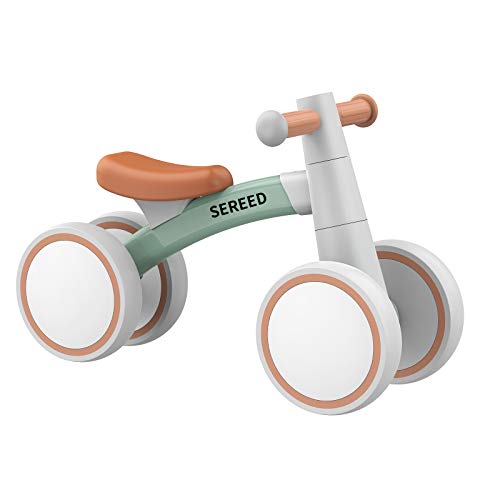
Best Budget: SEREED Baby Balance Bike for 1 Year Old Boy Girl, First Birthday Gift Toy
Best budget pick for baby’s very first ride
A 135° steering limiter and fully enclosed wheels protect tiny feet, making this sturdy aluminum bike a safe, affordable first ride for 1-year-olds.
- 135° steering limiter stops a 1-year-old from oversteering and toppling sideways
- Fully enclosed wheels keep curious little feet and fingers away from spokes
- Aluminum construction keeps it light enough for a brand-new walker to push around
- Cheap enough to gift without worrying about outgrowing it fast
- Smaller size range means it’s outgrown faster than the adjustable premium bikes
- Build quality feels noticeably more toy-like than the Strider or Retrospec frames
- Limited color and accessory options compared to established brands
Best for Smallest Riders: Yvolution Y Velo Junior 9" Balance Bike
Best fit for the smallest riders on two wheels
Dual rear wheels give the smallest, newest riders extra stability before graduating to a single-wheel balance bike, with a seat as low as 11 inches.
- Dual rear wheels add a stability crutch that single-wheel bikes can’t offer at 18 months
- Low 11 in. seat height fits kids who’d be too small for a standard 12 in. balance bike
- Adjustable seat and handlebar stretch its usable window as the child grows
- Compact 9 in. wheels keep the whole bike proportional to a very small rider
- 44 lb weight cap means it’s outgrown earlier than the 12 in. options
- Dual rear wheels eventually need to come off, adding an extra transition step
- Smaller wheels handle rough pavement and grass less smoothly than 12 in. wheels
Runner Up: Umatoll Baby Balance Bike Toy for 1 Year Old Boy Girl
Runner-up budget pick with a glow-wheel twist
A glow-in-motion rear wheel and ultralight 1.5 kg aluminum frame make this budget balance bike an engaging, easy-to-push first ride for 1-year-olds.
- Glow-in-motion wheel gives hesitant toddlers a reason to keep pushing and practicing
- 1.5 kg frame is among the lightest in this whole roundup
- Budget pricing makes it an easy first-birthday add-on gift
- Simple assembly, ready to ride in minutes out of the box
- Novelty glow feature can wear off in appeal after the first few weeks
- Less established brand track record than Strider or Retrospec
- Smaller seat adjustment range limits how long it stays useful
Side-by-side comparison
|
Best Overall
Strider 12 Sport, No Pedal Balance Bike for Kids A
|
Best Premium
Strider 12 Pro, Aluminum Balance Bike for Kids Age
|
Best Value
Retrospec Cub 2 Toddler 12" Balance Bike, 18 Month
|
Best Budget
SEREED Baby Balance Bike for 1 Year Old Boy Girl,
|
Best for Smallest Riders
Yvolution Y Velo Junior 9" Balance Bike – 2-in-1 N
|
Runner Up
Umatoll Baby Balance Bike Toy for 1 Year Old Boy G
|
|
|---|---|---|---|---|---|---|
|
|
|
|
|
|
|
|
| Frame Weight | 6.7 lb steel | 5.6 lb aluminum | Not specified (steel) | Lightweight aluminum | Not specified | 1.5 kg (~3.3 lb) aluminum |
| Age Range | 1-4 years | 1-5 years | 18 months-4 years | 1 year+ | 18 months-3 years | 1 year+ |
| Seat Height Range | 11-17 in. | 11-17 in. | 11-14.5 in. | Not specified | As low as 11 in. | Not specified |
| Tire Type | Flat-free foam | Flat-free foam | Flat-free foam | Solid, enclosed | Dual rear + front wheel | Solid rubber |
| Price | $149.99 | $199.99 | $59.99 | $36.99 | $59.99 | $39.99 |
| BUY NOW | BUY NOW | BUY NOW | BUY NOW | BUY NOW | BUY NOW |
What to look for in First Bikes and Balance-to-Pedal Transition Bikes
The single biggest factor in whether a toddler can actually use the bike. It should let them sit with both feet flat on the ground for confident balance training.
A toddler has to lift, carry, and maneuver the bike themselves. Every extra pound makes that harder and can turn a new rider off entirely.
Flat-free foam or solid tires mean the bike is always ready to ride, with no pumps, patches, or trips to the bike shop.
New riders instinctively overturn the handlebars, which can flip the front wheel sideways and cause a tumble. A steering limiter keeps turns within a safe range.
A wider age and seat range means the bike doesn’t get outgrown in a single season, which matters most for the price-conscious options.
What age should a kid start on a balance bike?
Most kids can start as early as 12-18 months once they’re walking confidently, using a low-seat model like the Yvolution Y Velo Junior or SEREED. By age 2-3, most toddlers are ready for a standard 12 in. balance bike like the Strider 12 Sport.
Do balance bikes really make training wheels unnecessary?
Yes, in most cases. Kids who master balance first learn to steer and stay upright before they ever touch pedals, so when they move to a pedal bike they typically skip stabilizers entirely and start pedaling within a few sessions.
How do I know if a balance bike's seat is too high?
Your child should be able to sit on the seat with both feet flat on the ground and knees slightly bent, not on tiptoes. If they can’t plant their feet, size down or pick a model with a lower minimum seat height.
Is a heavier steel frame or lighter aluminum frame better for a first bike?
For a brand-new 1-year-old rider, lighter aluminum (like the Strider 12 Pro or Umatoll) is easier to control and less discouraging. For a slightly older, sturdier 2-3 year old who’ll be rougher on the bike, steel’s extra durability is worth the added weight.
The bottom line
- Strider 12 Sport is the proven, do-it-all balance bike that grows with a toddler from age 1 to 4
- Strider 12 Pro is the lighter, longer-lasting upgrade for families who want the best possible ride feel
- Retrospec Cub 2 delivers adjustable convenience and flat-free tires without premium-brand pricing
- SEREED's balance bike is the cheapest safe way to get a 1-year-old started, steering limiter included
- Yvolution Y Velo Junior's dual rear wheels give the smallest, newest riders extra stability before going solo
- Umatoll's glow-wheel design is a fun, ultralight budget pick that keeps reluctant beginners motivated
The Strider 12 Sport is the safest default pick for most families thanks to its adjustable range and durable steel frame, while the Retrospec Cub 2 delivers nearly the same convenience for less money. For the youngest or most budget-conscious riders, the Yvolution Y Velo Junior and SEREED bike are built specifically for that first wobbly year.
Leave a Reply